Pyramid Field Notes · Ancient engineering
How did they build
the pyramids?
Some parts of the story are well documented. Others remain unresolved. Start with the Great Pyramid at Giza and explore the records, physical traces and experiments that help explain how stone reached the building site.
Start with a question
Which part would you like to explore?
Choose a stage to see what the sources tell us and which questions they leave open.
Where did the stone come from?
Quarry traces near the Great Pyramid support a nearby source for much of the core limestone. Merer’s diary records stone-loaded boat journeys from Tura to Khufu’s pyramid project.
Where the evidence stops
These sources help us understand supplies and delivery. They do not account for every block or explain how the stone was lifted and placed.
2 relevant sources · S5 + S1
Read the supporting sources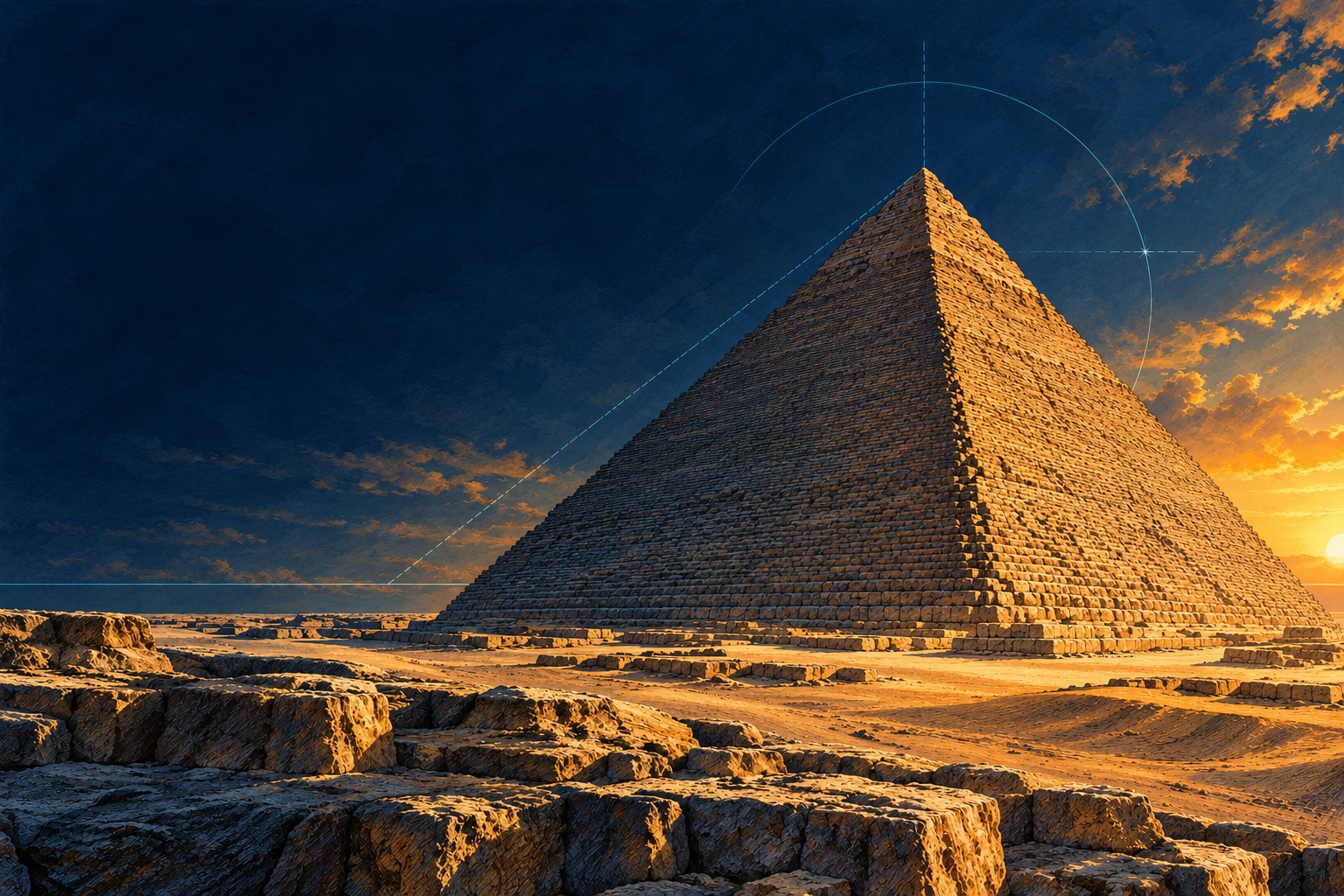
to pyramid
Moving stone by boat, hauling it over land and placing it in the pyramid are different problems. Evidence for one does not automatically explain the others.
Understanding the building process
A huge building job,
in four parts.
This diagram organises the questions. It does not show a proven construction sequence.
It is easier to follow the evidence when we separate the stages. A cargo record can tell us about a boat journey; an experiment can explain friction. Neither, on its own, tells us how a block was placed high in the pyramid.
Stone origin
Quarry traces
Cargo diary
River delivery
Written journeys
Reconstructed channel
Land hauling
Sand and friction
Controlled experiment
Lifting & placement
Quarry comparison
Unresolved at Giza
Choose the part that interests you, then follow the links to see what each source actually says.
Inside the Great Pyramid / ScanPyramids
Was the camera looking
inside the Big Void?
The camera confirmation concerns the north-face corridor. The large space reported in 2017 and the corridor described in 2023 are different discoveries, with different locations and different evidence.
Detected through muon measurements above the Grand Gallery
About 2 × 2 m in cross-section; later inspected with an endoscope
The bars compare the reported lengths using at least 30 m and about 9 m. They do not show shape, position or a connection. The paper’s abstract gives about 9 m for the corridor; CEA reports roughly 9.5 m.
Muon measurements help researchers infer a space within the stone. They are not photographs of its interior. The Big Void’s shape and purpose remain open questions; the later camera work concerns the separate corridor. Read the 2017 source and TUM’s camera report.
The 2017 author manuscript was read in full for these notes. The 2023 paper was checked at abstract and bibliographic level; institutional reports provide further context. Those access differences are explained alongside the sources.
Research for videos, podcasts and articles
Have a claim you want
to check before publishing?
Bring one specific question or a public link. The proposed research pilot helps you trace a claim back to accessible sources, understand what they leave unanswered and decide what you can responsibly say.
You can read the ScanPyramids example first to see how the findings, source links and uncertainties fit together.
See what the research brief includesA research brief for one question
£75 proposed pilot price
For an agreed £75 pilot, the brief would cover one claim using up to five accessible sources. You would receive 800–1,200 words with links and precise places to check, unanswered questions, notes on reuse and one follow-up clarification.
Scope, payment method and delivery date are agreed before work starts. This is an early pilot, with no verified customer or delivery-time results yet. The example shows the intended format; it is not client work.
How the notes are made
A useful answer should
show how it was reached.
The starting point is a narrow question, followed by accessible primary papers and reports from the people doing the research. Each note shows where to find the relevant passage, what was recorded or measured, and what the researchers infer from it.
Pyramid Field Notes is published by Two Cairns Studio, Fraser Hainey’s independent project. His practical background is in CAD and teaching. AI helps with research and drafting, while the published explanations remain tied to checked sources.
Read about the sources, imagery and research methodBefore you explore
A few useful things to know.
Does this site explain the complete construction method?
No complete sequence is established by the sources collected here. The aim is to make the evidence easier to follow, including the gaps. You can learn about stone supplies, recorded boat journeys and hauling experiments without treating them as proof of every later stage.
Are the images and diagrams archaeological reconstructions?
The pyramid image is an illustration made for this site. The stage diagram organises questions, and the length bars compare reported measurements. They do not reproduce a survey, a paper figure or a proven construction plan.
Where should I start?
Choose one of the four questions near the top of the page. Then open the source notes, where you can compare two sources, read their limits and follow the links to the original work.